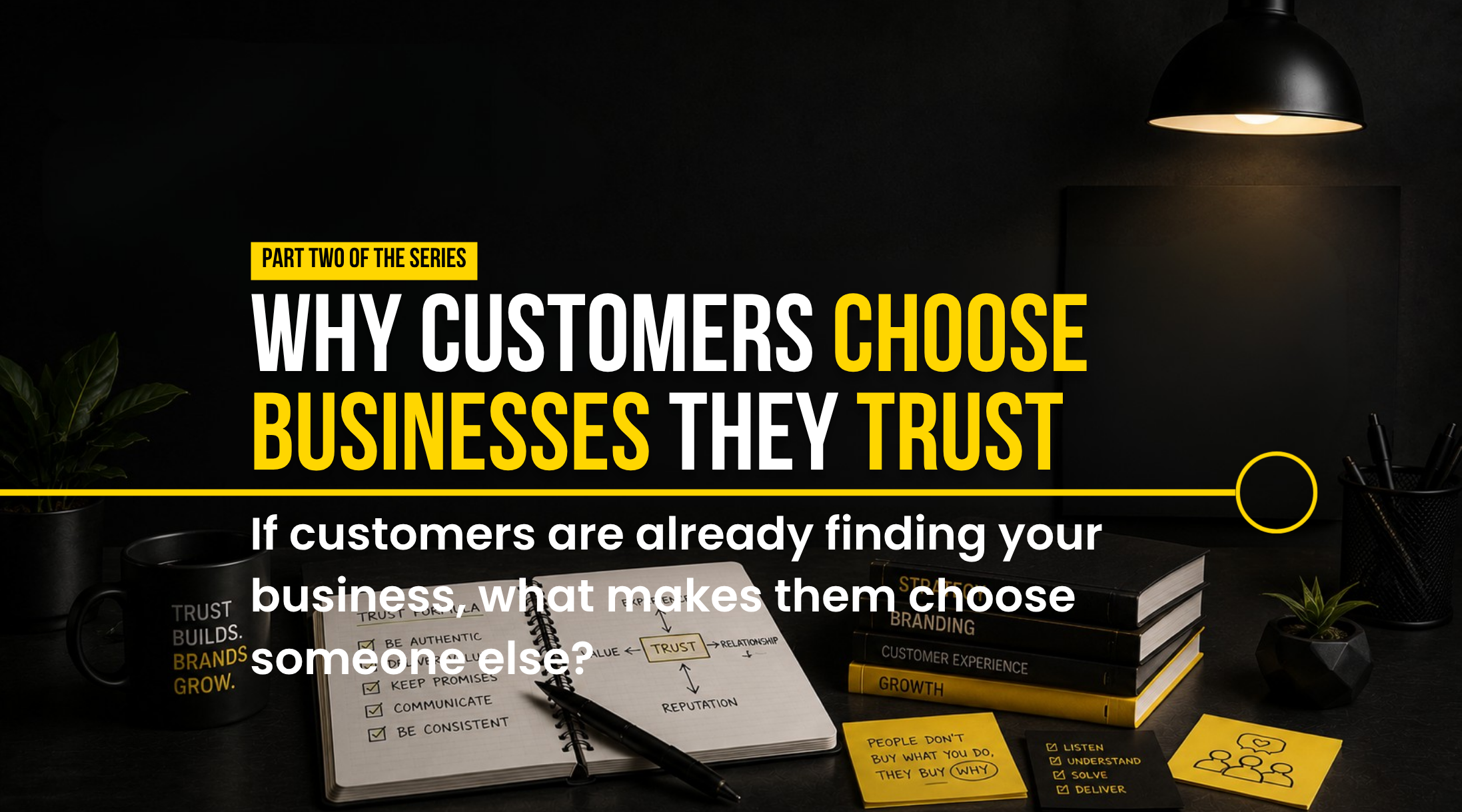
Part 2 of the Series: Why Marketing Alone Can’t Build Confidence
In Part 1, we explored why marketing before branding is a costly mistake. We concluded that marketing brings people to your business, but branding shapes what they experience once they arrive. This raises an even more important question: if customers are already finding your business, what makes them choose someone else?
Customers Rarely Buy the “Best” Business
Ask a group of entrepreneurs why they lost a potential customer, and you’ll hear familiar answers.
“Our competitor quoted a lower price.”
“They’ve been in business longer.”
“They probably had a bigger marketing budget.”
Those explanations are comforting because they’re easy to believe. They suggest the problem lies somewhere outside our control. But if you’ve been in business long enough, you’ve probably seen something that doesn’t quite fit this logic.
A small café with no celebrity endorsements has customers waiting outside every Sunday morning. A neighbourhood jeweller charges more than larger chain stores and still has loyal customers returning generation after generation. A boutique architecture firm wins projects against companies that are twice its size. These businesses aren’t always the cheapest, the oldest or the loudest. Yet people choose them with surprising confidence.
So what’s really happening?
The answer has less to do with products or services than most of us think. Before customers compare quality, features or pricing, they make a quieter decision.
“Does this business feel like a safe choice?”
That question is rarely spoken aloud, but it sits behind almost every purchase we make.
Every Purchase Is an Exercise in Reducing Risk
Buying something is rarely just an exchange of money.
It’s an act of trust.
Whether you’re spending ₹300 on dinner, ₹30,000 on a laptop or ₹30 lakh on a home renovation, you’re making a prediction about the future. You’re hoping the product will perform as promised, the service will meet expectations and the business will support you if something goes wrong.
The higher the investment, the greater the uncertainty.
Because customers can never know everything before they buy, their brains look for shortcuts. Psychologists call these heuristics—mental cues that help us make decisions without analysing every possible detail.
We all use them.
When choosing a restaurant, we glance at photographs before reading the menu. When selecting a doctor, we notice the clinic before evaluating qualifications. When hiring an architect, we often judge the website before requesting a portfolio.
These aren’t irrational behaviours.
They’re efficient ones.
The human brain constantly asks, “Do I have enough evidence to trust this decision?”
Businesses answer that question whether they realise it or not.
Confidence Is Built Long Before the Sales Conversation
Imagine you’re searching for an interior designer.
Two companies appear in your Google search results.
Both have positive reviews. Both claim years of experience. Both specialise in homes similar to yours.
You click on the first website.
The homepage immediately explains who they work with and what they stand for. Their project photographs follow a consistent visual style. The writing is clear, professional and easy to understand. Every page feels intentional, as though someone carefully considered the customer’s journey.
Now you visit the second website.
Nothing appears dramatically wrong. But the logo looks slightly blurry. Some pages use different fonts. The photographs vary wildly in quality. The messaging feels generic and could belong to almost any design firm.
Would you still compare quotations from both?
Probably.
But deep down, one business has already earned a little more confidence than the other.
That’s the part many businesses overlook.
Customers don’t suddenly decide to trust you after the first meeting.
They begin forming that opinion long before you’ve exchanged a single email.
The Confidence Economy
At Fishyhue Studio, we like to think of today’s marketplace as a confidence economy.
Customers don’t simply reward the business with the biggest advertising budget. They reward the business that makes the decision feel easier.
Every consistent touchpoint quietly answers the same question:
“Can I rely on these people?”
Your website answers it.
Your proposal answers it.
Your social media presence answers it.
Your packaging answers it.
Your email signature answers it.
Even the speed and clarity of your communication answers it.
Individually, these details seem small.
Together, they become the evidence customers use to judge your business.
That’s why branding isn’t decoration.
It’s evidence.
It’s a collection of signals that reduce uncertainty before the customer commits to buying.
The businesses that understand this don’t necessarily market more than everyone else.
They simply make every interaction reinforce the same message.
“We’re professional.”
“We’re consistent.”
“You can trust us.”
Customers may never consciously notice those signals.
But they almost always notice when they’re missing.
When Customers Start Negotiating, They’re Often Negotiating Risk
One of the biggest myths in business is that customers negotiate only because they want a lower price.
Sometimes that’s true.
More often, they’re negotiating because they’re trying to reduce uncertainty.
Imagine you’re planning a home renovation. Two contractors quote almost the same amount. One sends a professionally designed proposal, arrives on time for every meeting, has a website that reflects the quality of their work, and communicates clearly throughout the process. The other contractor may be equally skilled, but their quotation is a poorly formatted PDF, their WhatsApp profile still displays an old logo, and their website looks like it hasn’t been updated in years.
Who would you feel more comfortable paying an advance to?
The difference isn’t capability.
It’s confidence.
The contractor who appears more organised has already reduced part of the customer’s perceived risk. The second contractor now has to answer more questions, justify their experience, provide additional references and, quite often, reduce their price simply to overcome the uncertainty created by inconsistent presentation.
That’s an expensive problem to solve.
Not because the work is inferior, but because confidence was never established in the first place.
The Cost of Making Customers Think
There’s an idea we often discuss at Fishyhue Studio.
Every unnecessary question in a customer’s mind creates friction.
Questions like:
“Are these people experienced enough?”
“Why does the website look different from their Instagram page?”
“Is this company still active?”
“Will they actually deliver what they’re promising?”
None of these questions help customers make a buying decision.
They delay it.
The human brain prefers certainty. When information feels incomplete or inconsistent, we naturally slow down. We compare more options, seek more opinions and postpone decisions until we feel comfortable.
Businesses experience this every day without recognising it.
The customer who says, “We’ll think about it,” isn’t always rejecting your proposal.
Sometimes they’re simply looking for more confidence.
Great branding doesn’t pressure people into buying.
It removes the unnecessary doubts that stop them from buying.
Why Some Businesses Feel Easier to Buy From
Think about brands like Paper Boat.
The drinks themselves may compete in a crowded market, yet almost everything surrounding the product feels intentional. The nostalgic storytelling, the packaging, the illustrations, the language and the overall experience reinforce the same personality. Whether you see a social media post or pick up a bottle in a supermarket, it feels unmistakably like Paper Boat.
The same principle applies to businesses that may never become household names.
A local jewellery store with consistent branding often feels more trustworthy than a larger competitor with inconsistent communication. A boutique architecture studio that presents itself professionally can command higher fees than a bigger firm whose customer experience feels fragmented. Even neighbourhood cafés become memorable because every touchpoint—from the menu and takeaway cups to the interiors and social media—creates the same emotional impression.
Customers don’t consciously analyse these details.
They simply remember how the business made them feel.
That’s why branding isn’t about making your business look beautiful.
It’s about making your business feel dependable.
Marketing Can Create Attention. Only Experience Creates Reputation.
This is where many businesses unintentionally waste money.
Every new advertising campaign creates another opportunity for someone to experience your business. If that experience consistently builds confidence, marketing becomes more effective over time because every satisfied customer strengthens your reputation.
But if the experience feels inconsistent, every campaign simply exposes the same weaknesses to a larger audience.
Imagine inviting one hundred people into a store with confusing signage, poorly trained staff and products displayed randomly across the shelves.
Now imagine inviting one thousand.
The larger audience doesn’t solve the underlying problem.
It magnifies it.
Digital marketing works in much the same way.
More clicks don’t automatically create more customers.
Sometimes they simply reveal where customers lose confidence.
The Businesses That Grow Fastest Understand One Thing
Businesses often ask,
“How can we generate more leads?”
It’s an important question.
But the businesses that build lasting brands usually ask something slightly different.
“How can we make choosing us feel easier?”
That shift changes everything.
Instead of focusing only on attracting attention, they begin improving every stage of the customer journey. Their messaging becomes clearer. Their visual identity becomes more consistent. Their proposals become easier to understand. Their websites answer questions before customers ask them. Their communication reflects the same professionalism as the service they provide.
None of these improvements directly increase advertising reach.
Yet together, they quietly increase something far more valuable.
Customer confidence.
Fishyhue Insight
Customers don’t buy when they’re completely convinced.
They buy when they’ve stopped doubting.
The role of branding isn’t to persuade people through clever design.
It’s to remove enough uncertainty that saying “yes” feels like the obvious next step.
Looking Ahead
If Part 1 showed why marketing before branding is a costly mistake, and this chapter explored why customers naturally gravitate towards businesses they trust, there’s still one important question left to answer.
How do you actually build that trust?
Is it the logo?
The colours?
The website?
The messaging?
Or is it something much bigger than all of those combined?
In the next part, we’ll explore what branding really includes, why many businesses mistake visual identity for branding itself, and how creating a simple, consistent brand system can make your business easier to recognise, easier to trust and significantly easier to remember.
Like what you see?
Every successful logo begins with a clear strategy, not just creativity. If you’re ready to build a brand that communicates trust, personality, and long-term value, we’d love to help.
Continue Reading → Part 3: Branding Is More Than a Logo: Building a Brand System That Customers Remember