How weak branding quietly reduces conversions, weakens trust, and makes every marketing rupee work harder
Two businesses spend the same amount on marketing. Both receive similar traffic. Yet one consistently turns visitors into customers while the other struggles to justify every advertising rupee. The difference isn’t always the advertising. More often than not, it begins long before the first campaign goes live.
The Problem Most Businesses Try to Solve
Ask any business owner what’s stopping their growth, and the answer is surprisingly consistent.
“We need more enquiries.”
“We need more leads.”
“People don’t know we exist.”
These aren’t wrong. Every business, whether it’s a law firm in Delhi, a café in Kolkata, a construction company in Hyderabad or a D2C startup operating from a spare bedroom, depends on visibility. If people don’t know you exist, they can’t become customers. Naturally, marketing becomes the first priority. A website goes live, social media pages are created, Google Ads begin running, Meta campaigns are launched, and SEO finds its place somewhere on the monthly to-do list.
For a while, everything seems to move in the right direction. Website traffic increases, social media reach improves and enquiries begin arriving. Then something unexpected happens. Visitors browse a few pages and leave. Prospective customers ask for quotations but never respond. Meetings are scheduled but don’t convert. The phone rings often enough to feel encouraging, but not enough to sustain consistent growth.
The immediate conclusion is understandable: the marketing isn’t working.
Sometimes that’s true.
But not nearly as often as people think.
Why More Traffic Doesn’t Always Mean More Business
Imagine two interior design firms operating in the same city. They target the same audience, allocate the same ₹1 lakh marketing budget and even run similar Google Ads. Their advertisements receive almost identical click-through rates because the headlines, keywords and offers are equally compelling.
On paper, the campaigns look remarkably similar.
The difference appears only after someone clicks.
One visitor lands on a website that feels organised and reassuring. The messaging is clear, the portfolio is professionally presented, the colours remain consistent across every page, the photography reflects the quality of work, and every interaction quietly reinforces the feeling that this is an experienced firm.
The second visitor lands on another website. The services are similar, but the experience isn’t. The logo appears different on various pages, the copy feels generic, the project photographs lack consistency, and the website doesn’t quite resemble the company’s social media profiles. Nothing is obviously wrong, yet nothing inspires complete confidence either.
Both businesses attracted the click.
Only one earned the customer’s trust.
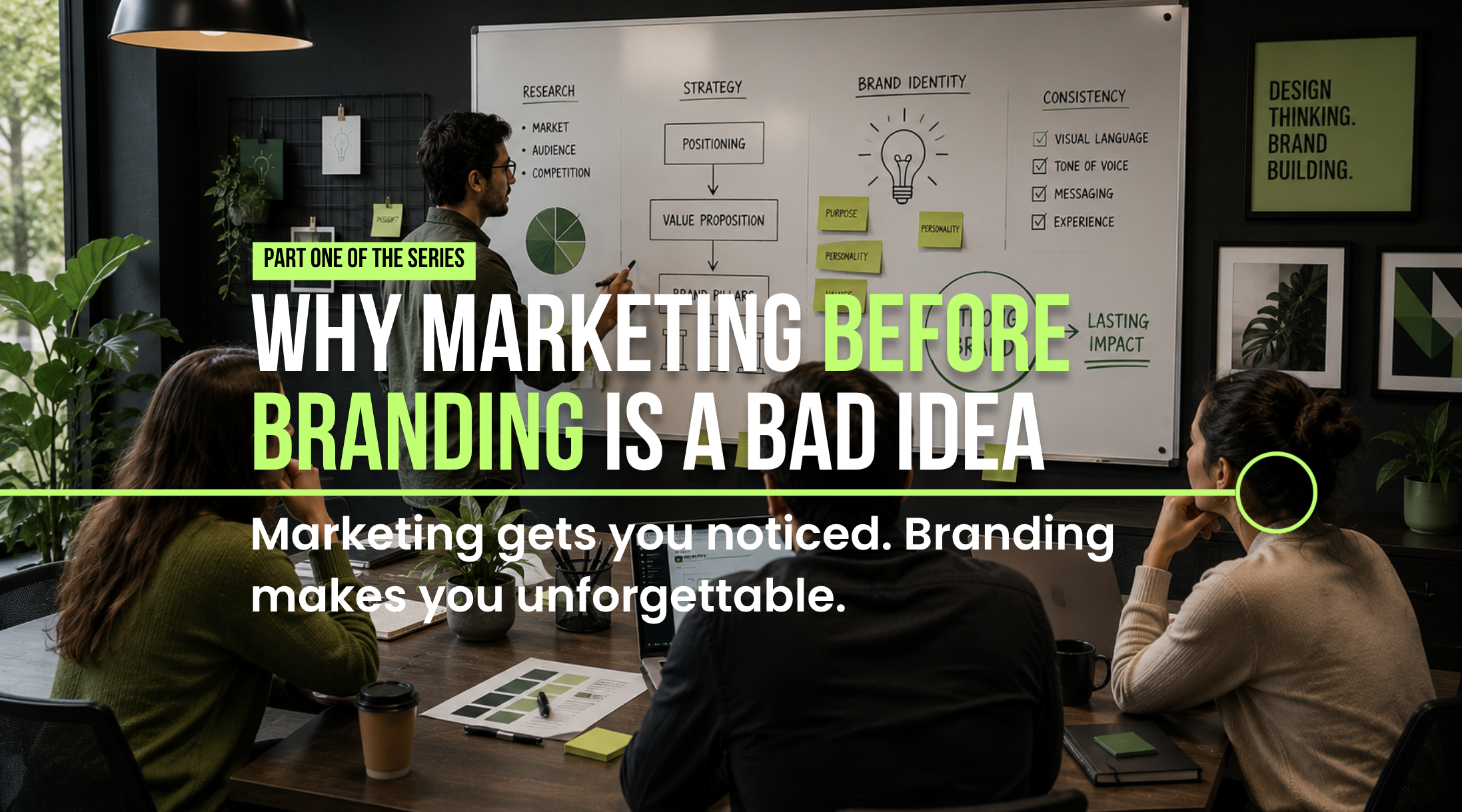
That’s an important distinction because marketing and branding influence different stages of the customer journey. Marketing helps people discover your business. Branding influences what they feel after they’ve discovered it.
In other words, marketing wins the click. Branding wins the customer.
The Moment Branding Actually Begins
One of the biggest misconceptions in business is believing that branding starts when a designer opens Adobe Illustrator.
It doesn’t.
Branding begins the moment someone forms an opinion about your business.
That opinion might be shaped by a Google search result, your website, a LinkedIn profile, a product package, an invoice, a proposal or even your WhatsApp Business profile. Customers don’t consciously score these touchpoints one by one. Instead, their brains combine dozens of small observations into a single impression.
“This business seems reliable.”
Or…
“Something feels off.”
What’s fascinating is that most customers couldn’t explain exactly why they reached that conclusion. Human beings constantly rely on mental shortcuts to make decisions. We simply don’t have the time or information to analyse every business objectively, so our brains look for signals instead. Consistency, clarity and professionalism become indicators of competence. Inconsistency, even when unintentional, introduces uncertainty.
That’s why two equally capable businesses can produce very different results from the same marketing investment.
The difference isn’t always who attracted more visitors.
It’s who made visitors feel more confident once they arrived.
Why Businesses Confuse Branding with Marketing
The confusion is understandable because branding and marketing often appear together.
A new advertising campaign usually includes new graphics. A website redesign often coincides with a marketing push. Social media content mixes visual identity with promotional messaging. From the outside, everything seems connected.
But their jobs are completely different.
Marketing answers one question:
“How do we get more people to notice our business?”
Branding answers another:
“Now that they’ve noticed us, why should they choose us?”
That’s why increasing your advertising budget doesn’t automatically improve your business. If visitors aren’t convinced after they arrive, spending more money simply sends more people to the same experience.
It’s a bit like filling a beautifully designed showroom with potential customers while forgetting to train the sales team. More visitors don’t solve the underlying problem; they simply expose it more quickly.
The uncomfortable truth is that marketing doesn’t create trust.
It reveals whether trust already exists.
That’s why businesses sometimes feel trapped in an endless cycle of advertising. Every month begins with another campaign because the previous one generated attention but failed to build lasting confidence. The marketing wasn’t necessarily ineffective—it was being asked to solve a problem that belonged to branding.
And that’s where many businesses unknowingly make their most expensive mistake.
A Brand Is Built Long Before Loyalty
There’s another reason businesses underestimate branding: they assume it’s something customers notice only after they’ve made a purchase. In reality, branding begins influencing decisions much earlier.
Think about your own behaviour for a moment. When you’re looking for a new restaurant, a doctor, an architect or even a CA, you don’t immediately compare prices or technical expertise. You first decide whether the business looks credible enough to deserve your attention. Only then do you invest your time in reading reviews, comparing services or requesting a quotation.
Your customers behave exactly the same way.
This is why branding isn’t simply about creating a memorable logo or choosing attractive colours. Those are important, but only because they’re part of a much larger system. Every interaction a customer has with your business either reinforces confidence or quietly chips away at it. Your website, proposal, invoice, email signature, packaging, social media posts, photography and even the way you answer enquiries all contribute to a single impression.
Most customers will never consciously say, “I chose them because their typography was consistent.”
What they will say is, “They seemed more professional.”
That’s branding translated into business language.
The Cost of Waiting
Many founders postpone branding because they see it as something they’ll invest in once the business starts growing.
Ironically, that’s often the stage when branding becomes more difficult and more expensive.
Imagine opening a retail store with temporary signage because “we’ll replace it later.” Six months pass, and the same temporary sign is still hanging outside. Meanwhile, you’ve printed visiting cards, brochures, shopping bags, invoices and uniforms using that temporary identity. Customers have already formed an impression of your business, employees have become accustomed to it, and changing everything now requires far more time and money than doing it properly at the beginning.
The same thing happens digitally.
Businesses launch websites that don’t reflect who they are, create social media pages without a clear visual identity, publish inconsistent content and then spend heavily on advertising. Every campaign attracts more visitors, but it also exposes those inconsistencies to a larger audience.
That’s why weak branding doesn’t merely fail to help your marketing.
It quietly reduces the return on every marketing investment you make.
Every click becomes slightly less valuable.
Every enquiry becomes slightly harder to convert.
Every customer requires a little more convincing.
Over months and years, those small inefficiencies compound into a significant business cost.
Marketing Isn’t the Villain
At this point, it’s worth clarifying something important.
This isn’t an argument against marketing.
Far from it.
Exceptional businesses need exceptional marketing. Advertising introduces your business to people who may never have discovered it otherwise. Search engines, social media, email campaigns and referrals all play a crucial role in growth. The mistake isn’t investing in marketing.
The mistake is expecting marketing to compensate for problems it was never designed to solve.
Imagine inviting hundreds of guests to your home before you’ve finished preparing it. The invitations weren’t the problem. In fact, they worked perfectly. People arrived exactly as expected.
The question is whether what they found matched the expectations you created.
Businesses often find themselves in the same situation. They focus on increasing traffic without asking whether the experience waiting on the other side deserves that traffic. Marketing can generate curiosity, but curiosity alone doesn’t create customers.
Confidence does.
And confidence is built through branding.
Before You Spend on Your Next Campaign…
Before approving the budget for your next Google Ads campaign or planning another month of social media content, pause for a moment and ask yourself a different set of questions.
If two strangers visited your website today, would they immediately understand what makes your business different?
Would every touchpoint—from your logo and messaging to your portfolio and proposal—tell the same story?
Would your business feel established, trustworthy and memorable, even if someone had never heard of you before?
If the answer to those questions is uncertain, your next investment may not need to be a larger advertising budget.
It may need to be a stronger brand.
That’s because marketing doesn’t create the first impression.
It simply creates the opportunity for one.
And opportunities, no matter how expensive they are to generate, only become customers when the experience that follows lives up to the promise.
Like what you see?
Every successful logo begins with a clear strategy, not just creativity. If you’re ready to build a brand that communicates trust, personality, and long-term value, we’d love to help.
Continue Reading
In the next part of this series, we’ll explore why great marketing can’t rescue weak branding. We’ll look at why some businesses keep increasing their advertising budgets without seeing better results, how customers make trust decisions within seconds, and why strong brands often outperform better businesses with significantly smaller marketing budgets.
Continue Reading → Part 2: Why Great Marketing Can’t Rescue Weak Branding